
The Bill Gleason Story
1978-1981
The first male candidate for Homecoming Queen at University of the Pacific.
Where it began.
While looking through Pacific on the Rise: The Story of California's First University at Pacific, a book written by Philip Gilbertson about the history of Pacific, my partner and I came across one sentence that triggered a deeper search into the topic of Homecoming Queen. This one sentence was the following:
"And when the feminist movement arose in the late sixties, the homecoming queen and her court vanished until the pageantry was revived in 1977.”
What was the process of shutting down this tradition? Did students fight back? Was it really about feminism? Why was it revived? Popular demand or did the wave of feminism fade out?
When we first started our research, we thought we would get some clear cut answers, but we were wrong. We came upon some of the most interesting stories containing scandal and drama. Our favorite story, by far, was Bill Gleason's.
Bill Gleason was an undergrad student at University of the Pacific from 1978-1981. He was an International Studies major who was an active member of the Forensic team as well as intramural sports and Band Frolic. Oh! And he was nominated and ran for Homecoming Queen of 1979. Bill Gleason stood as a symbol of all the complaints and issues with the Homecoming Queen tradition.
Bill's Motivation

Every candidate for Homecoming Queen was selected by a "living group" on campus (essentially residential housing and registered student organizations). Bill Gleason was elected by the John Ballantyne residential hall counsel to run for Homecoming Queen as a way to protest "... beauty contests as 'sexist, exclusive, and shallow'. The dorm council contends that instead of refusing an entry, a male candidate speaks of a much stronger complaint.” In this quote we learn that John Ballantyne almost never elected anyone for the 1979 court, but to emphasize their point, they selected a male candidate to draw more attention. What did Bill Gleason think? Well, it was said in another quote from The Pacifican that Bill refused "to use the term ‘Homecoming Queen’ in his speech for the first round competition substituting the title of ‘person to represent the University of the Pacific during Homecoming festivities.” It is clear that Bill was promoting John Ballantyne hall counsel's motivation for electing him as well as pushing for a more inclusive title. Bill's story does not end here. The next semester, in Spring of 1980, Bill was a highlight of yet another (very large) article in The Pacifican about getting a sex change so he could run and win the Homecoming Queen election. Right away readers can tell that this is a joke thanks to a very provocative (and insulting) image (can be seen below). In this article, Gleason takes a more aggressive approach to his original arguments against this Homecoming tradition. He mocks the female body talking about his new curves, his new breasts and even going so far as to say “...how can a little girl like me know how to behave in this great big world without him - someone might try to take advantage of me, you know.” His original points were far more professional, did this just made a joke out of his and his constituents' agenda?

Bill's Influence
The 1980 Homecoming Election rolls around (the semester after Bill Gleason's "sex change") and a new male candidate steps up to carry on Bill Gleason's original message. Bill Kochenderfer, a write-in candidate, was quoted in The Pacifican to have said “University tradition would probably consider it to be more of a joke, but it is almost a matter of equal rights. It (Homecoming Queen) should be made Homecoming Person. Maybe all the participants will turn out to be female, that is fine, as long as the contest is more representative of the entire university.” It was also said in this same article that “According to Kochenderfer, the Homecoming Queen should be ‘someone who will represent the entire campus, with competition based on merit rather than looks.’ He received the impression that he was dropped for reasons other than merit.” Both Bill Gleason and Bill Kochenderfer wanted the title change and a Queen (or Homecoming Person) that represents the student body. But, was it just Bill Gleason and Bill Kockenderfer pushing this agenda?
Were the Bill's alone?
In the same paper that Bill Kochenderfer spoke on why he felt he was not voted into the top 5, another article titled "Homecoming tradition discriminates against the non-beautiful" written by an Anne Baker, makes some strong points. Anne Baker starts her article “It’s homecoming weekend and that age-old sexist tradition of Homecoming Queen is back again. The reason this contest is sexist is that it insinuates that beauty and talent run along the same line.” This goes far beyond a representative queen and emphasizes a deeper problem; that women are being judged on their looks, discouraging other women from entering. To some this may not seem like a big problem, if someone wanted to run for homecoming queen and get elected by their living group, they could. But, the self doubt and self judgement that women undergo due to social norms of "beauty" is incredibly harmful. Anne Baker said it perfectly when she said "She feels she has already lost before she starts.” Baker then speaks on another large issue in this same article. Noticing that there is an issue with elections, Baker went to the voting center and asked an individual that was collecting votes if there was somewhere she could take her complaints and the person responded that "there wasn’t anywhere I could go to express my feelings and have any effect.” Sadly, this vote collector was right. Six years after Anne wrote that article Kristin Schwellenbach wrote an article titled "A Homecoming reminiscence" in which she stated "The election of a Homecoming King and Queen has always been a source of controversy to those who view it as a contest based on looks and popularity, not involvement on academic achievement."
Is it possible that other women have tried voicing their complaints and were ignored or not listen to? Anne was seemingly ignored and six years later Kristin claims that individuals are still feeling that this contest is anything but based on merit. You might be asking the same question we were asking at this point... were there any women involved in the Homecoming Court who had something to say about the processes? Yes.
Janeen Krabbenschmidt was the Homecoming Queen of 1969. A year after her election she wrote an article and published it in The Pacifican. The article was titled "Queen for a day - then what". In this article Janeen speaks on her discontent with the judges as well as their questions they chose to judge the girls on. The article said that "Janeen was not impressed with their performances as judges. According to Janeen, the final judges asked trivia-type questions similar to those which have have made the intellectual finale of the Miss America Pageant a farce." She continued that "the student panel had been concerned with more important issues (birth control, politics, etc.); thus, the first panel seemed to have more justification as selectors than did the second." Janeen is emphasizing that there is no reason for these random business men from Stockton to be included in the election process. That students at Pacific were far more intellectual with their questioning, so why involve these men? Janeen then mentioned that once you become Homecoming Queen that "people use you" and that "whatever living group she is in capitalizes on the fact that she is Homecoming Queen and she becomes a portable example of superiority for the group...". Of course, this is not the worst thing in the whole world, however, it is a problem that after the experience, Janeen felt used.
Carrie Hayward was on the Homecoming Court of 1995, the last year of the Homecoming King and Queen tradition. Carrie expresses in the beginning of her article her original beliefs of what the Homecoming Court experience was like such as her "mental image of rows of beaming blonde sorority girls trotting around the football field in sequined evening gowns after finishing the swimsuit competition..." or "I pictured the application with multiple choice questions about height, weight, and measurements, and a short question regarding world salvation." However, she was surprised when she found out that selection was based on a combination of G.P.A., essay application, interview, and extracurricular activity. She said it "sounded more like a scholarship application than the popularity contest I thought it was." So, Carrie jumped into the process as she felt it was her "journalistic duty to inform... the truth behind the pleasant Homecoming Court...". Carrie then goes over each day after applying for Homecoming Court very quickly, rushing us through the experience possibly trying to make her reader feel the way she did. She explains at the very end of the article that she was "more disappointed by the mundanity of the whole experience than my failure to win the crown."
As we can see, a few similarities pop up here. The quickness of the process, the ideas that were created around the election, the mundanity of the experience itself. There was one large difference however. In Carrie Hayward's year there was a large scandal. Carrie summarized it perfectly in her article that "several candidates were sending friends to vote for them multiple times. Additionally, we were all violating sections of at least one of the numerous editions of the McCaffrey Center postings policy. Consequently, we were all disqualified and the election results were thrown out." It was fully explained in other articles that the votes from students were not taken into consideration, only the application scores were counted. The difference between Carrie and Janeen was that it seemed Carrie was pleased student votes weren't being counted, that "the Homecoming popularity contest was abolished." Meanwhile, back in 1969, Krabbenschmidt was wanting a student vote, not some random older men judging them based on ill-defined adjectives. It was two years later that the Homecoming court tradition was completely shut down due to the lack of student participation and voice in the elections. It was 1977 when it was brought back with the first article emphasizing how the student's voice is the deciding factor (literally being titled "Homecoming Queen, You Pick the One"). Maybe if Carrie knew what it used to be and what Janeen Krabbenschmidt (and many other young women) fought for, she would not be as dismissive of the student voice in this election.
Janeen Krabbenschmidt and
Carrie Hayward

Janeen Krabbenschmidt

Carrie Hayward
And now, a Homecoming King.
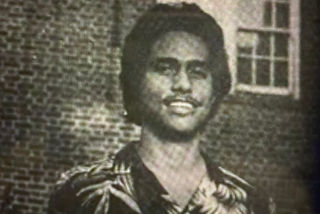
1981 marked the first year of a Homecoming King being included in the Homecoming tradition. The inclusion of a king was added 2 years after Bill Gleason's original running for Homecoming Queen, 1 year after Bill Kochenderfer's running, and 1 year after Bill Gleason's "sex change" article. Is it possible that they are responsible for the inclusion of a male contest? Was their "unconventional" protest the reason for a more inclusive tradition on campus? One that now doubles their possible student representatives and might encourage some individuals who never thought they had a chance to win to run for Homecoming court.
Leslie Kuali'i
The first Homecoming King at University of the Pacific (1981).
Thirteen years passed by with not one controversial article about the Homecoming election process. No scandals, no dramatics. It was not until the last Homecoming Court in 1995 (Carrie Hayward's Homecoming year) that a scandal came about. Sadly, this was how the Homecoming tradition ended - on a bad note. Some may say that the tradition just fizzled out and some may say that it ended because the football program closed in 1995 and they didn't want any lingering traditions to remind students of their beloved football. Either way, the timeline of Homecoming Court at University of the Pacific's campus came to it's end.
Despite the fact that current Pacific students do not get to experience a Homecoming Court, Bill Gleason's actions still hold great value. He opened the eyes of many individuals in the late 1970s to the idea of equitability, the importance of accurate representation, and inclusive language. He opened a gate way for individuals who might have felt on the outside of what was deemed "normal" or "standard" for Homecoming Queen and allowed them to see that they too could step forward and cause waves. Although his message shifted to an unconventional approach, one could see why he took it to the level he did because that would cause conversations and serious consideration of equitable elections. Bill Gleason may not be a well known name on campus today, but his message lives on.
The end.
Story Timeline
Mentioned Articles
Please look through the images below of all of the articles we used in the paragraphs above. We also included some articles about the rubrics that were used for rating the women throughout the years as well as some extra articles by students on Homecoming.
All articles can be found in University of the Pacific's Digital Archives page. Simply search the date provided below the image and it will bring you to a downloadable pdf of the full newspaper.
Link to Pacific's Digital Archives page: https://scholarlycommons.pacific.edu/ua/


